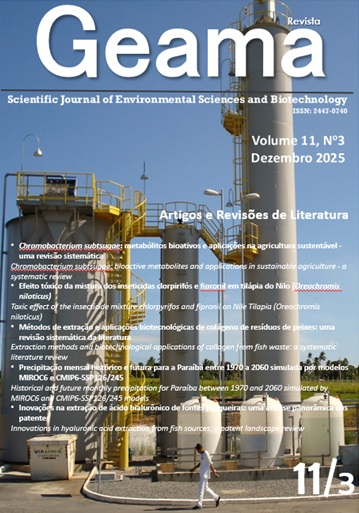
Chromobacterium subtsugae: metabólitos bioativos e aplicações na agricultura sustentável - uma revisão sistemática
Palavras-chave:
inseticida, bioinsumos, controle biológico, cromamida A, violaceínaResumo
O mercado de bioinsumos agrícolas desempenha um papel crucial na produção de alimentos e desenvolvimento sustentável, visto que a construção de tecnologias pautadas em agentes microbianos pode assegurar resiliência aos sistemas de cultivo e reduzir os impactos antrópicos sobre o planeta. Neste estudo, foi realizado um levantamento sistemático do potencial para agricultura de Chromobacterium subtsugae, incluindo o aparato gênico e funcional associado às suas atribuições no setor agrícola. Buscas foram conduzidas em bases de dados conforme o protocolo PRISMA e a triagem foi realizada conforme critérios de elegibilidade com produções entre 2007 e 2024. As buscas identificaram 3.896 referências, das quais 25 foram incluídas pelos critérios estabelecidos. Uma patente foi adicionada à revisão, totalizando 26 referências. Os estudos revelam a síntese de violaceína, cianeto de hidrogênio, quitinases e toxinas por cepas da espécie. Mecanismos inexplorados na espécie foram evidenciados neste estudo, como a produção de sideróforos associada à promoção de crescimento vegetal, além de dados escassos acerca da cromamida A, principal metabólito associado à ação inseticida da espécie. Cepas da espécie possuem atividade nematicida, acaricida e potencial inseticida contra espécies das ordens Coleoptera, Hemiptera, Diptera e Lepidoptera. Esses dados consolidam a espécie como uma ferramenta viável e sustentável para o setor agrícola, capaz de contribuir com a segurança alimentar global.Downloads
Referências
AJIJAH, N.; FIODOR, A., PANDEY, A. K.; RANA, A.; PRANAW, K. Plant growth-promoting bacteria (PGPB) with biofilm-forming ability: a multifaceted agent for sustainable agriculture. Diversity, v. 15, n. 1, p. 112, 2023. https://doi.org/10.3390/d15010112
ASOLKAR, R.; HUANG, H.; KOIVUNEN, M.; MARRONE, P. Chromamide A (1), compositions comprising chromamide A (1) with insecticidal activity. Depositante: Marrone Bio Innovations, Inc. EP n. 2632272B1. Depósito: 24 out. 2011. Concessão: 21 ago. 2019.
AYAN, L. B.; COUTIÑO, P. M.; GONZÁLEZ, M. M.; VÁZQUEZ, R. L.; HERNÁNDEZ, F. G. Microorganismos del suelo y sus usos potenciales en la agricultura frente al escenario del cambio climático. Magna Scientia UCEVA, v. 1, n. 1, p. 104-117, 2021. DOI: : https://doi.org/10.54502/msuceva.v1n1a14
BAJSA, N.; FABIANO, E.; RIVAS-FRANCO, F. Biological control of phytopathogens and insect pests in agriculture: an overview of 25 years of research in Uruguay. Environmental Sustainability, v.6, n.2, p.121-133. 2023. DOI: https://doi.org/10.1007/s42398-023-00275-8
BALUSU, R. R.; FADAMIRO, H. Y. Evaluation of organically acceptable insecticides as stand?alone treatments and in rotation for managing yellowmargined leaf beetle, Microtheca ochroloma (Coleoptera: Chrysomelidae), in organic crucifer production. Pest management science, v.68, n.4, p.573-579. 2012. DOI: https://doi.org/10.1002/ps.2297
BALUSU, R.; FADAMIRO, H. Y. Susceptibility of Microtheca ochroloma (Coleoptera: Chrysomelidae) to botanical and microbial insecticide formulations. Florida Entomologist, v.96, n.3, p.914-921. 2013. DOI: https://doi.org/10.1653/024.096.0327
BLACKBURN, M. B.; SPARKS, M. E.; GUNDERSEN-RINDAL, D. E. The genome of the insecticidal Chromobacterium subtsugae PRAA4-1 and its comparison with that of Chromobacterium violaceum ATCC 12472. Genomics data, v.10, n.1, p.1-3. 2016. DOI: https://doi.org/10.1016/j.gdata.2016.08.013
CALVIN, W.; BEUZELIN, J. M.; LIBURD, O. E.; BRANHAM, M. A.; SIMON, L. J. Effects of biological insecticides on the sugarcane aphid, Melanaphis sacchari (Zehntner) (Hemiptera: Aphididae), in sorghum. Crop Protection, v.142, n.1, p.105528. 2021. DOI: https://doi.org/10.1016/j.cropro.2020.105528
CLARK, M. M.; BRODERICK, N. A. Whole-genome sequencing of Chromobacterium subtsugae strains exhibiting toxicity to Drosophila melanogaster. Microbiology Resource Announcements, v.13, n.6, p.e00127-24. 2024. DOI: https://doi.org/10.1128/mra.00127-24
DIAS, K. C. F. P.; DA SILVA SOUZA, I. J.; BARROS, Y. C.; DA SILVA, E. P.; LEITE, J.; FEITOZA, A. F. A.; DE JESUS SANTOS, A. F. Native bacteria from the caatinga biome mitigate the effects of drought on melon (Cucumis melo L.). Comunicata Scientiae, v. 15, p. e4072-e4072, 2024. DOI: https://doi.org/10.14295/cs.v15.4072
FANNING, P. D.; GRIESHOP, M. J.; ISAACS, R. Efficacy of biopesticides on spotted wing drosophila, Drosophila suzukii Matsumura in fall red raspberries. Journal of Applied Entomology, v.142, n.1, p.26-32. 2018. DOI: https://doi.org/10.1111/jen.12462
GOLEC, J. R.; HOGE, B.; WALGENBACH, J. F. Effect of biopesticides on different Tetranychus urticae Koch (Acari: Tetranychidae) life stages. Crop Protection, v.128, n.1., p.105015. 2020. DOI: https://doi.org/10.1016/j.cropro.2019.105015
GYAWALI, P.; KIM, H.; VANCE, D. R.; KHODAVERDI, H.; MANTRI, A.; NANSEN, C. Can Insects Assess Environmental Risk? Movement Responses and Nymph Emergence in Response to Insecticides. Agriculture, v.13, n.3, p.723. 2023. DOI: https://doi.org/10.3390/agriculture13030723
HOWLAND, A. D.; COLE, E.; POLEY, K.; QUINTANILLA, M. Alternative Management Strategies and Impact of the Northern Root-Knot Nematode in Daylily Production. Plant Health Progress, v.24, n.2, p.180-187. 2023. DOI: https://doi.org/10.1094/PHP-08-22-0076-RS
LEE, D. H.; SHORT, B. D.; NIELSEN, A. L.; LESKEY, T. C. Impact of organic insecticides on the survivorship and mobility of Halyomorpha halys (Stål) (Hemiptera: Pentatomidae) in the laboratory. Florida Entomologist, v.97. n.2, p.414-421. 2014. DOI: https://doi.org/10.1653/024.097.0211
LOO, C.; KOIRALA, P.; SMITH, N. C.; EVANS, K. C., BENOMAR, S.; PARISI, I. R.; OLLER, A.; CHANDLER, J. R. Cross-species activation of hydrogen cyanide production by a promiscuous quorum-sensing receptor promotes Chromobacterium subtsugae competition in a dual-species model. Microbiology, v.169, n.2, p.001294. 2023. DOI: https://doi.org/10.1099/mic.0.001294
MAL, S.; PANCHAL, S. Drought and salt stress mitigation in crop plants using stress-tolerant auxin-producing endophytic bacteria: a futuristic approach towards sustainable agriculture. Frontiers in Plant Science, v. 15, p. 1422504, 2024. DOI: https://doi.org/10.3389/fpls.2024.1422504
MARTIN, P. A. W.; BLACKBURN, M. B. Characterization of the insecticidal activity of Chromobacterium subtsugae. Biopesticides International, v.4, n.2, p.102-109. 2008. DOI:
MARTIN, P. A.; GUNDERSEN-RINDAL, D.; BLACKBURN, M., BUYER, J. Chromobacterium subtsugae sp. nov., a betaproteobacterium toxic to Colorado potato beetle and other insect pests. International Journal of Systematic and Evolutionary Microbiology, v.57, n.5, p.993-999. 2007a. DOI: https://doi.org/10.1099/ijs.0.64611-0
MARTIN, P. A.; HIROSE, E.; ALDRICH, J. R. Toxicity of Chromobacterium subtsugae to southern green stink bug (Heteroptera: Pentatomidae) and corn rootworm (Coleoptera: Chrysomelidae). Journal of Economic Entomology, v.100. n.3, p.680-684. 2007b. DOI: https://doi.org/10.1093/jee/100.3.680
MERMER, S.; TAIT, G.; PFAB, F.; MIRANDOLA, E.; BOZARIC, A.; THOMAS, C. D.; MOELLER, M., OPPENHEIMER, K. G.; XUE, L.; WANG, L.; WALTON, V. M. Comparative insecticide application techniques (micro-sprinkler) against Drosophila suzukii Matsumura (Diptera: Drosophilidae) in highbush blueberry. Environmental entomology, v.51, n.2, p.413-420. 2022 DOI: https://doi.org/10.1093/ee/nvac002
OLIVEIRA-HOFMAN, C.; COTTRELL, T. E.; BOCK, C.; MIZELL III, R. F.; WELLS, L.; SHAPIRO-ILAN, D. I. Impact of a biorational pesticide on the pecan aphid complex and its natural enemies. Biological Control, v.161, n.1, p.104709. 2021. DOI: https://doi.org/10.1016/j.biocontrol.2021.104709
OUZZANI, M.; HAMMADY, H.; FEDOROWICZ, Z.; ELMAGARMID, A. Rayyan—a web and mobile app for systematic reviews. Systematic reviews, v.5, n.1, p.1-10. 2016. DOI: https://doi.org/10.1186/s13643-016-0384-4
PAGE, M. J.; MCKENZIE, J. E.; BOSSUYT, P. M.; BOUTRON, I.; HOFFMANN, T. C.; MULROW, C. D., SHAMSEER, L.; TETZLAFF, J. M.; AKL, E. A.; BRENNAN, S. E.; CHOU, R.; GLANVILLE, J.; GRIMSHAW, J. M.; HRÓBJARTSSON, A.; LALU, M. M.; LI, T.; LODER, E. W.; MAYO-WILSON, E.; MCDONALD, S.; MCGUINNESS, L. A.; STEWART, L. A.; THOMAS, L.; TRICCO, A. C.; WELCH, V. A.; WHITING, P.; MOHER, D.. The PRISMA 2020 statement: an updated guideline for reporting systematic reviews. bmj, v.372, n.72. 2021. DOI: https://doi.org/10.1186/s13643-016-0384-4
PATHMUDI, V. R.; KHATRI, N.; KUMAR, S.; ABDUL-QAWY, A. S. H.; VYAS, A. K. A systematic review of IoT technologies and their constituents for smart and sustainable agriculture applications. Scientific African, v.19, n.1, p.e01577. 2023. DOI: https://doi.org/10.1016/j.sciaf.2023.e01577
POVEDA, J.; EUGUI, D.. Combined use of Trichoderma and beneficial bacteria (mainly Bacillus and Pseudomonas): Development of microbial synergistic bio-inoculants in sustainable agriculture. Biological Control, v. 176, p. 105100, 2022.
RAY, H. A.; HOY, M. A. Effects of reduced-risk insecticides on three orchid pests and two predacious natural enemies. Florida Entomologist, v.97, n.3, p.972-978. 2014. DOI: https://doi.org/10.1653/024.097.0355
ROCHA, T. M.; MARCELINO, P. R. F.; DA COSTA, R. A. M.; RUBIO-RIBEAUX, D.; BARBOSA, F. G.; DA SILVA, S. S. Agricultural Bioinputs Obtained by Solid-State Fermentation: From Production in Biorefineries to Sustainable Agriculture. Sustainability, v.16, n.3, p.1076. 2024. DOI: https://doi.org/10.3390/su16031076
ROGERS, M. A.; OWNLEY, B. H.; AVERY, P. B.; WSZELAKI, A. L. Toxicity and efficacy of novel biopesticides for organic management of cucumber beetles on Galia muskmelons. Organic Agriculture, v.7, n.1, p.365-377. 2017. DOI: https://doi.org/10.1007/s13165-016-0161-7
SARMIENTO, L.; VITERI, D. M.; LINARES, A. M.; CABRERA, I. Bio-ensayos de insecticidas biológicos y orgánicos sintéticos en larvas del gusano de la mazorca del maíz [Helicoverpa zea (Boddie) (Lepidoptera: Noctuidae)]. J. Agric. Univ. PR, v.105, n.1. 2021. DOI: https://doi.org/10.46429/jaupr.v105i2.20081
SEPPELT, R.; KLOTZ, S.; PEITER, E.; VOLK, M. Agriculture and food security under a changing climate: An underestimated challenge. Iscience, v.25, n.12, p.105551. 2022. DOI: https://doi.org/10.1016/j.isci.2022.105551
SHANNAG, H. K.; CAPINERA, J. L. Comparative effects of two novel betaproteobacteria based insecticides on Myzus persicae (Hemiptera: Aphididae) and Phenacoccus madeirensis (Hemiptera: Pseudococcidae). Florida Entomologist, v.101, n.2, p.212-218. 2018. DOI: https://doi.org/10.1653/024.101.0209
SHAPIRO-ILAN, D. I.; COTTRELL, T. E.; BOCK, C.; MAI, K.; BOYKIN, D.; WELLS, L.; HUDSON, W. G; MIZELL III, R. F. Control of pecan weevil with microbial biopesticides. Environmental entomology, v.46, n.6, p.1299-1304. 2017. DOI: https://doi.org/10.1093/ee/nvx144
SHAPIRO–ILAN, D. I.; COTTRELL, T. E.; JACKSON, M. A.; WOOD, B. W. Control of key pecan insect pests using biorational pesticides. Journal of Economic Entomology, v.106, n.1, p.257-266. 2013. DOI: https://doi.org/10.1603/ec12302
SIAL, A. A.; ROUBOS, C. R.; GAUTAM, B. K.; FANNING, P. D.; VAN TIMMEREN, S.; SPIES, J.; PETRAN, A.; ROGERS, M. A.; LIBURD, O. E.; LITTLE, B. A.; CURRY, S.; ISAACS, R. Evaluation of organic insecticides for management of spotted?wing drosophila (Drosophila suzukii) in berry crops. Journal of applied entomology, v.143, n.6, p.593-608. 2019. DOI: https://doi.org/10.1111/jen.12629
VÖING, K.; HARRISON, A., SOBY, S. D. Draft genome sequences of three Chromobacterium subtsugae isolates from wild and cultivated cranberry bogs in southeastern Massachusetts. Genome Announcements, v.3, n.5, p. e00998-15. 2015. DOI: https://doi.org/10.1128/genomeA.00998-15
VÖING, K.; HARRISON, A.; SOBY, S. D. Draft genome sequence of Chromobacterium subtsugae MWU12-2387 isolated from a wild cranberry bog in Truro, Massachusetts. Genome announcements, v.5, n.12, p. e01633-16. 2017. DOI: https://doi.org/10.1128/genomea.01633-16
Downloads
Publicado
Como Citar
Edição
Seção
Licença
Copyright (c) 2025 Revista Geama

Este trabalho está licenciado sob uma licença Creative Commons Attribution-NonCommercial-ShareAlike 4.0 International License.
As Políticas Culturais em Revista aplica a Licença Creative Commons Atribuição-Não Comercial 4.0 Internacional (CC BY-NC-SA 4.0) para os trabalhos que publica. Esta licença foi desenvolvida para facilitar o acesso aberto - ou seja, o acesso livre, imediato, e a reutilização irrestrita de trabalhos originais de todos os tipos. Nossos autores mantêm os direitos autorais mas, sob essa licença, concordam em deixar os artigos legalmente disponíveis para reutilização, sem necessidade de permissão ou taxas, para praticamente qualquer finalidade. Qualquer pessoa pode copiar, distribuir ou reutilizar esses artigos, desde que o autor e a fonte original (Políticas Culturais em Revista) sejam devidamente citados.