Adenocarcinoma of the esophagogastric junction in a dog
DOI:
https://doi.org/10.26605/medvet-v19n1-6874Keywords:
canine, cancer, esophagus, stomach, neoplasiaAbstract
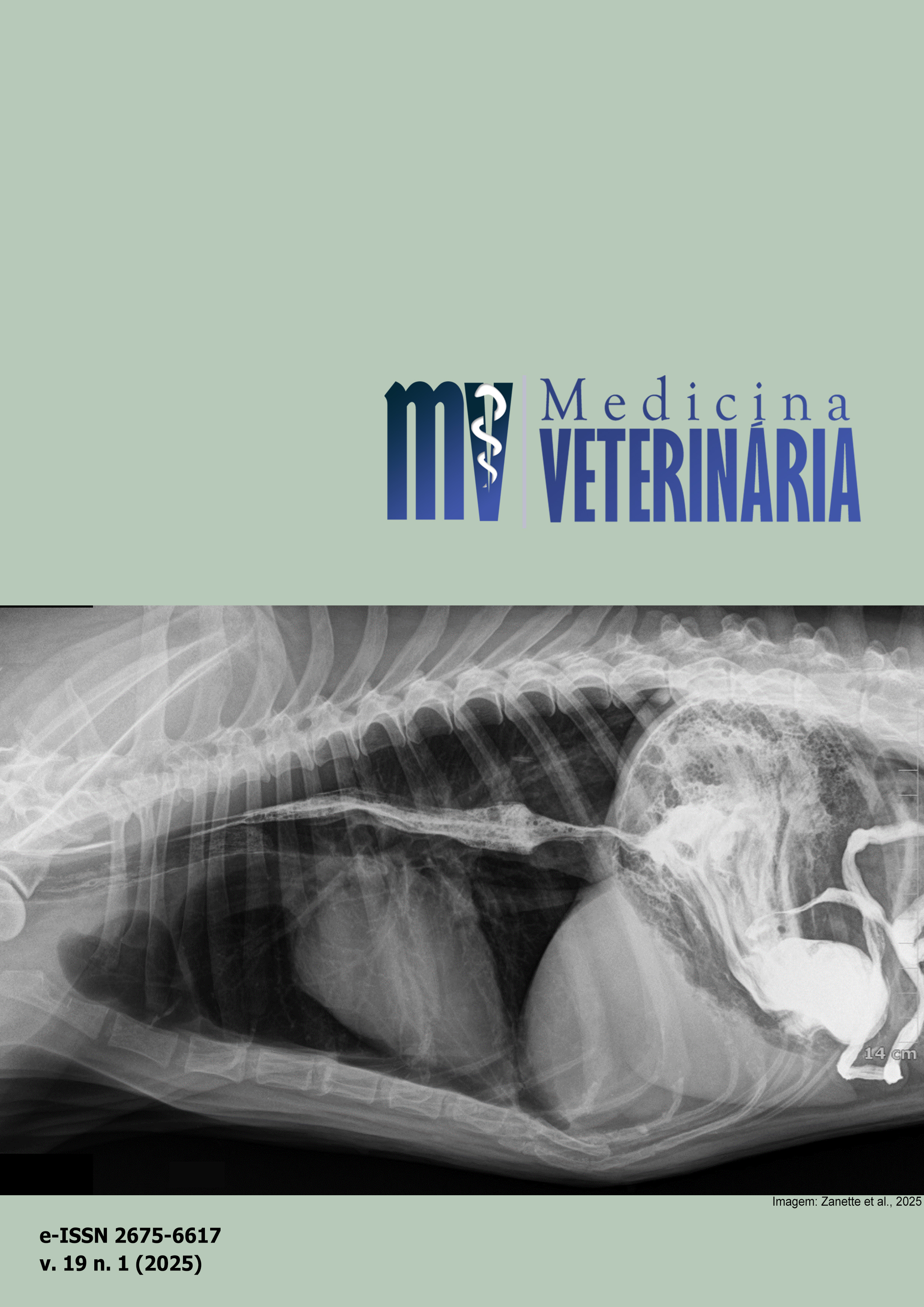
Primary esophageal tumors in dogs and cats are rare and the main types in the species can be epithelial (papilloma and squamous cell carcinoma) or mesenchymal (leiomyoma, leiomyosarcoma, fibrosarcoma, osteosarcoma or undifferentiated sarcomas). This study aimed to describe the clinical and anatomopathological characteristics of a tumor in the esophagogastric junction in a dog. A 12-year-old neutered male Pitbull dog with a history of hyporexia and weight loss for two months, was received at a veterinary teaching clinic in Campinas, São Paulo. The initial clinical suspicion of megaesophagus was ruled out by imaging tests and the esophagram suggested obstruction at the esophagogastric junction. During the period of additional examinations, even with adjustments in dietary management, there was rapid and marked weight loss and clinical worsening, which led the owners to opt for the animal's euthanasia. At necropsy examination, the cadaver was emaciated and a large, white, firm, intramural mass was observed at the esophagogastric junction, causing marked obstruction of food flow. Microscopically, the tumor consisted of an epithelial neoplasm, with a tubular arrangement, and distribution from the lamina propria of the esophagus to the submucosal, muscular, and adventitial tunics of the organ. There was neoplastic infiltration in the submucosa and muscularis of the adjacent stomach, in addition to foci of metastasis in the liver, mesenteric lymph nodes, and adrenal gland. The morphological diagnosis was tubular adenocarcinoma in the esophagogastric junction. Although rare, this type of cancer should be considered in the differential diagnosis of esophageal disorders that cause regurgitation and chronic weight loss in dogs.Downloads
References
Barbosa, F.M.S. et al. Adenosquamous carcinoma of the cervical oesophagus in a dog. Ciência Rural, 50(7): e20190788, 2020.
Berube, D. et al. Primary esophageal squamous cell carcinoma in a cat. Journal of the American Animal Hospital Association, 45(6): 291-295, 2009.
Chambers, J.K. et al. Adenocarcinoma of Barrett’s esophagus in a dog. Journal of toxicologic pathology, 30(3): 239-243, 2017.
Farese, J.P. et al. Oesophageal leiomyosarcoma in dogs: surgical management and clinical outcome of four cases. Veterinary and comparative oncology, 6(1): 31-38, 2008.
Garman, K. S. Origin of Barrett’s epithelium: esophageal submucosal glands. Cellular and Molecular Gastroenterology and Hepatology, 4(1): 153-156, 2017.
Guedes et al. Sistema digestório. In: Santos, R.L.; Alessi, A.C. Patologia veterinária 3ª ed. Rio de Janeiro: Guanabara Koogan, 2023. p.103-220.
Kapoor, H. et al. Animal models of Barrett's esophagus and esophageal adenocarcinoma–past, present, and future. Clinical and translational science, 8(6): 841-847, 2015.
Kawaura, Y. et al. Immunohistochemical study of p53, c-erbB-2, and PCNA in Barrett's esophagus with dysplasia and adenocarcinoma arising from experimental acid or alkaline reflux model. Journal of gastroenterology, 36: 595-600, 2001.
Kleine, L.J. Radiologic examination of the esophagus in dogs and cats. Veterinary Clinics of North America, 4(4):663-86, 1974.
Lam, A.K.Y. Updates on World Health Organization classification and staging of esophageal tumors: implications for future clinical practice. Human Pathology, 108: 100-112, 2021.
Levine, M.C. Esophageal Squamous Cell Carcinoma and Adenocarcinoma. In: Levy, A.D.; Mortele, K.J.; Yeh, B.M. Gastrointestinal imaging. New York: Oxford University Press, 2015. p.36-39.
Munday J.S.; Löhr, C.V.; Kiupel, M. Tumors of the alimentary tract. In: Meuten DJ. Tumors in domestic animals. 5th ed. Hoboken: Wiley-Blackwell, 2017. p.499–601.
Odze R.D.; Lam, A.K.; Ochiai, A; Washington, M.K. Tumours of the oesophagus. In:_____ WHO classification of tumours- digestive system tumours. 5th ed. Lyon: IARC, 2019. p.23-58.
Okanishi, H.; Shibuya, H.; Miyasaka, T. Adenosquamous carcinoma of the oesophagus in a dog. Journal of Small Animal Practice, 56(8): 521-523, 2015.
Spagnoli, S.T.; Gelberg, H.B. Alimentary System and the Peritoneum, Omentum, Mesentery, and Peritoneal Cavity. In: Zachary, J.F. Pathologic basis of veterinary disease. 7th ed. St. Louis: Elsevier, 2022. p.396-485.
Trumpatori, B.J.; White, R.A.S. Tumours of the oesophagus. In: Dobson J.M., Lascelles BDX (eds.): BSAVA Manual of Canine and Feline Oncology. 3rd ed. Gloucester: British Small Animal Veterinary Association, 2011. p.206–208.
Turner, A.I. Cancer of the esophagus and stomach. In: Bruyette, D.S. Clinical small animal internal medicine. New Jersey: John Wiley & Sons, 2020. p.1283–1286.
Uzal, F.A.; Plattner, B.L.; Hostetter, J.M. Alimentary system. In: Maxie, M. G. Jubb, Kennedy & Palmer's pathology of domestic animals: Volume 2. 6th ed. St. Louis: Elsevier, 2016. p.1-257.
Venker-van-Haagen, A. Esophagus. In: Washabau, R.J.; Day, M.J. Canine and feline gastroenterology. 1st ed. St. Louis: Elsevier, 2013. p. 570–605.
Willard, M.D. Alimentary neoplasia in geriatric dogs and cats. Veterinary Clinics: Small Animal Practice, 42(4): 693-706, 2012.
Downloads
Published
How to Cite
Issue
Section
License
Copyright (c) 2025 Maurício Franco Zanette, Juliana Aparecida Bombardelli, Ronaldo Gomes Gargano, Felipe Nunes Felippe, Claudia Kiyomi Minazaki, Alex Junior Souza de Souza

This work is licensed under a Creative Commons Attribution-NonCommercial-ShareAlike 4.0 International License.
A Revista de Medicina Veterinária permite que o autor retenha os direitos de publicação sem restrições, utilizando para tal a licença Creative Commons CC BY-NC-SA 4.0.
De acordo com os termos seguintes:
Atribuição — Você deve dar o crédito apropriado, prover um link para a licença e indicar se mudanças foram feitas. Você deve fazê-lo em qualquer circunstância razoável, mas de nenhuma maneira que sugira que o licenciante apoia você ou o seu uso.
NãoComercial — Você não pode usar o material para fins comerciais.
CompartilhaIgual — Se você remixar, transformar, ou criar a partir do material, tem de distribuir as suas contribuições sob a mesma licença que o original.
Sem restrições adicionais — Você não pode aplicar termos jurídicos ou medidas de caráter tecnológico que restrinjam legalmente outros de fazerem algo que a licença permita.