Simultaneous ruptures of the palmar carpal ligament and superficial digital flexor tendon in a traction horse
DOI:
https://doi.org/10.26605/medvet-v19n1-6892Palabras clave:
equine orthopedics, clinical cases, locomotor system, forelimbsResumen
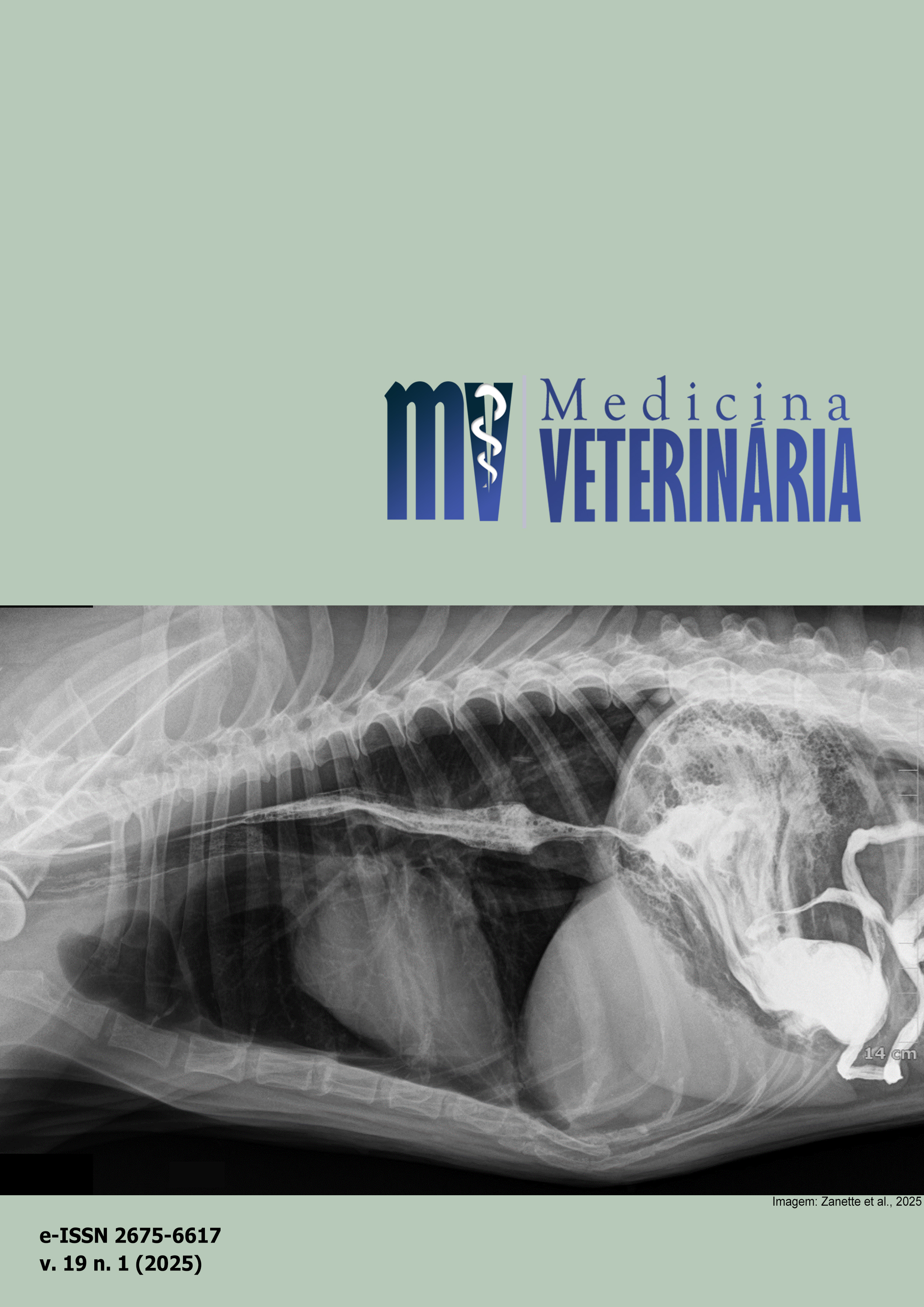
This report described the clinical case of a gelding, approximately 13 years old, mixed breed, with concomitant ruptures in the forelimbs, including the left palmar carpal ligament and the right superficial digital flexor tendon. After the clinical examination, it was observed severe hyperextension in the carpal joint and swelling, heat and intense pain in both thoracic limbs, in addition to reluctance to move and severe degree of lameness. In the radiographic examination, the right forelimb showed hyperextension of the radiocarpal joint with 225° and the presence of lateral subluxation of the carpal-ulnar bone and the left forelimb had hyperextension of the same joint with an angle of 235°. After euthanasia, partial multifocal tearing of the carpal palmar ligament was observed in the left thoracic limb and total tearing of the superficial digital flexor tendon in the right forelimb. This study presented the case and discussed the possible causes of the occurrence of concurrent ruptures. Also, the report explored equine carpal hyperextension, a rare condition with limited recovery records following palmar carpal ligament rupture injuries. It emphasizes the biomechanical role of this ligament, and its synergy with the superficial digital flexor tendon in preventing hyperextension. Although tendon ruptures have treatment options, complete rupture of the palmar carpal ligament often leads to euthanasia due to irreparable joint damage.Descargas
Citas
Amaral, L.A.; Rabassa, V.; Marchiori, M.; Meirelles, M.; Amado, M.; Nogueira, C.E.W. Use of lidocaine hydrochloride 2% intrathecally associated with prior anesthesia with thiopental as a method of euthanasia in horses. Ars Veterinaria, 27(1): 011-016, 2011.
Back, W.; Barneveld, A.; Van Weeren, P.R.; Van Den Bogert, A.J. Kinematic gait analysis in equine carpal lameness. Acta Anatomica (Basel), 146: 86–89, 1993.
Barba, M.; McMaster, M.; Albanese, V.; Cole, R.; Caldwell, F.; Schumacher, J. Carpal hyperextension in a Percheron mare caused by a palmar carpal ligament tear. Equine Veterinary Education, 26(7): 347-352, 2014.
Barr, A.R. Carpal conformation in relation to carpal chip fracture..Veterinary Record, 134: 646-650, 1994.
Biewener, A.A. Muscle-tendon stresses and elastic energy storage during locomotion in the horse. Comparative Biochemistry & Physiology Part B: Biochemical and Molecular Biology, 120(1), 73–87, 1998.
Bonilla-Gutiérrez, A.F.; López, C.; Carmona, J.U. Regenerative therapies for the treatment of tenodesmic injuries in horses. Journal of Equine Veterinary Science, 73: 139-147, 2019.
Burn, J.F.; Portus, B.; Brockington, C. The effect of speed and gradient on hyperextension of the equine carpus. The Veterinary Journal, 171: 169-171, 2006.
Carazzato, J.G. Lesões musculotendíneas e seu tratamento. Revista Brasileira de Ortopedia, 29(10): 723-728, 1994.
Clayton, H.M.; Schamhardt, H.C.; Willemen, M.A.; Lanovaz, J.L.; Colborne, G.R. Kinematics and ground reaction forces in horses with superficial digital flexor tendinitis. American Journal of Veterinary Research, 61: 191–196, 2000.
Dahlgren, L.A. Pathobiology of tendon and ligament injuries. Clinical Techniques in Equine Practice, 6(3): 168-173, 2007.
Davankar, S.P.; Deane, N.J.; Davies, A.S.; Firth, E.C.; Hodge, H.; Parry, D.A.D. Collagen fibril diameter distributions in ligaments and tendons of the carpal region of the horse. Connective Tissue Research, 34(1): 11-21, 1996.
De Filippo, M.; Sudberry, J. J.; Lombardo, E.; Corradi, M.; Pogliacomi, F.; Ferrari, F. S.; Bocchi, C.; Zompatori, M. Pathogenesis and evolution of carpal instability: imaging and topography. Acta Biomedica, 77(3): 168-180, 2006.
Denoix, J.M. Functional anatomy of tendon and ligaments in the distal limbs (manus and pes). The Veterinary Clinics of North America: Equine Practice, 10(2) 273-322, 1994.
Denoix, J.M. Biomechanics and physical training of the horse. 1st ed. Boca Raton: CRC Press, 2014. 192p.
Dyce, K.M.; Sack, W.O.; Wensing, C.J.G. Textbook of veterinary anatomy. Philadelphia: W. B. Saunders Company, 1987. p.554-567.
Engiles, J.B.; Stewart, H.; Janes, J.; Kennedy, L.A. A diagnostic pathologist's guide to carpal disease in racehorses. Journal of Veterinary Diagnostic Investigation, 29(4): 414-430, 2017.
Evans, D.L. Physiology of equine performance and associated tests of function. Equine Veterinary Journal, 39(4): 373-383, 2007.
FAWC. Farm Animal Welfare Committee. Opinion on the welfare of animals killed on-farm. 2017. Available at: . Accessed on: 24 jan. 2022.
Getty, R. Sisson and Grossman's The Anatomy of the Domestic Animals. Vol 1. 5th ed. Philadelphia: Saunders, 1975. 1286p.
Jorgensen, J.S.; Genovese, R.L. Superficial digital flexor tendonitis. In: Ross, M.W.; Dyson, S.J. (Eds). Diagnosis and Management of Lameness in the Horse. 1st ed. St Louis: W.B. Saunders, 2003. p.628-642.
Lam, K.K.H. Comparative epidemiology of tendon injuries in different racing disciplines. The Veterinary Journal, 195(3): 265-266, 2012.
Nagy, A.; Dyson, S. The challenge of diagnosing soft tissue injuries in the palmar aspect of the carpus. Equine Veterinary Education, 26(7): 353-356, 2014.
Palmer, S.; Barlow, D.; Ji-Chun, X. Kinematics of the Equine Carpus. In: Gillespie, J.R.; Robinson, N.E. (Eds). Equine Exercise Physiology 2. Davis, CA: ICEEP Publications, 1987. p.599-606.
Patterson-Kane, J.C.; Rich, T. Achilles tendon injuries in elite athletes: lessons in pathophysiology from their equine counterparts. ILAR Journal, 55(1): 86-99, 2014.
Pepe, M.; Beccati, F.; Gialletti, R.; Moriconi, F. Bilateral rupture of the palmar carpal ligament in a horse suffering from acute diaphragmatic hernia. Journal of Equine Veterinary Science, 33(1): 57-61, 2013.
Piermattei, D.L.; Flo, G.L.; DeCamp, C E. Fractures and other orthopedic conditions of the carpus, metacarpus, and phalanges. In: ____. Brinker, Piermattei and Flo’s handbook of small animal orthopedics and fracture repair. 4th ed. St. Louis, Missouri: Saunders Elsevier, 2006. p.382-428.
Schade, J.; Baldissera, R.; Paolini, E.; Fonteque, J.H. Biometria do equilíbrio podal em equinos de tração pertencentes ao Programa de Extensão “Amigo do Carroceiro” do Centro de Ciências Agroveterinárias da Universidade do Estado de Santa Catarina no município de Lages/SC, Brasil. Ciência Rural, 43(3): 456-461, 2013.
Segat, H.J.; Braga, D.N.; Samoel, G.V.A.; Porto, I.P.Ó.; Weiblen, C.; Rodrigues, F.S.; Vogel, F.S.F.; Pereira, D.I.B.; Sangioni, L.A.; Botton, S.A. Equinos Urbanos de Tração: Interação Social, Sanidade e Bem Estar Animal. Investigação, 15(4): 71-76, 2016.
Serra Bragança, F.M.; Hernlund, E.; Thomsen, M.H.; Waldern, N.M.; Rhodin, M.; Byström, A.; van Weeren, P.R.; Weishaupt, M.A. Adaptation strategies of horses with induced forelimb lameness walking on a treadmill. Equine Veterinary Journal, 53(3): 600-611, 2021.
Smith, L.J.; Mair, T.S. Rupture of the superficial flexor tendon in the forelimb in aged horses: a report of nine cases. Equine Veterinary Education, 19(4): 183-186, 2007.
Smith, M.A.; Dyson, S.J.; Murray, R.C. The appearance of the equine metacarpophalangeal region on high?field vs. standing low?field magnetic resonance imaging. Veterinary Radiology & Ultrasound, 52(1): 61-70, 2011.
Whitlock, D.; Garcia, T.C.; Vallance, S.A.; Stover, S.M. Possible role of carpal hyperextension in superficial digital flexor tendinopathy. Equine Veterinary Journal, 44: 559-563, 2012.
Whitton, R.C.; Rose, R.J. The intercarpal ligaments of the equine midcarpal joint, part 2: the role of the palmar intercarpal ligaments in the restraint of dorsal displacement of the proximal row of carpal bones. Veterinary Surgery, 26(5): 367-373, 1997.
Descargas
Publicado
Cómo citar
Número
Sección
Licencia
Derechos de autor 2025 Gino Luigi Bonilla Lemos Pizzi; Roberta Blake; Daniel Henrique Vieira Cavalcante, Karina Holz, Leandro Américo Rafael, Charles Ferreira Martins

Esta obra está bajo una licencia internacional Creative Commons Atribución-NoComercial-CompartirIgual 4.0.
- A Revista de Medicina Veterinária permite que o autor retenha os direitos de publicação sem restrições, utilizando para tal a licença Creative Commons CC BY-NC-SA 4.0.
- De acordo com os termos seguintes:
- Atribuição — Você deve dar o crédito apropriado, prover um link para a licença e indicar se mudanças foram feitas. Você deve fazê-lo em qualquer circunstância razoável, mas de nenhuma maneira que sugira que o licenciante apoia você ou o seu uso.
- NãoComercial — Você não pode usar o material para fins comerciais.
- CompartilhaIgual — Se você remixar, transformar, ou criar a partir do material, tem de distribuir as suas contribuições sob a mesma licença que o original.
- Sem restrições adicionais — Você não pode aplicar termos jurídicos ou medidas de caráter tecnológico que restrinjam legalmente outros de fazerem algo que a licença permita.